
We will call you back during our working hours between 9:00 AM and 5:00 PM
The range of thermal insulation materials is quite wide, but the most traditional ones in Ukraine today are mineral wool and extruded polystyrene foam. Each of these materials has its advantages and disadvantages. Mineral wool is non-combustible, but absorbs moisture and clodes, extruded polystyrene foam lasts longer, but is a highly combustible material (G3-G4), foam glass has more advantages, but the cost of the material is very high.
PIR insulation (polyisocyanurate) favorably stands out from the rest of these thermal insulation materials.
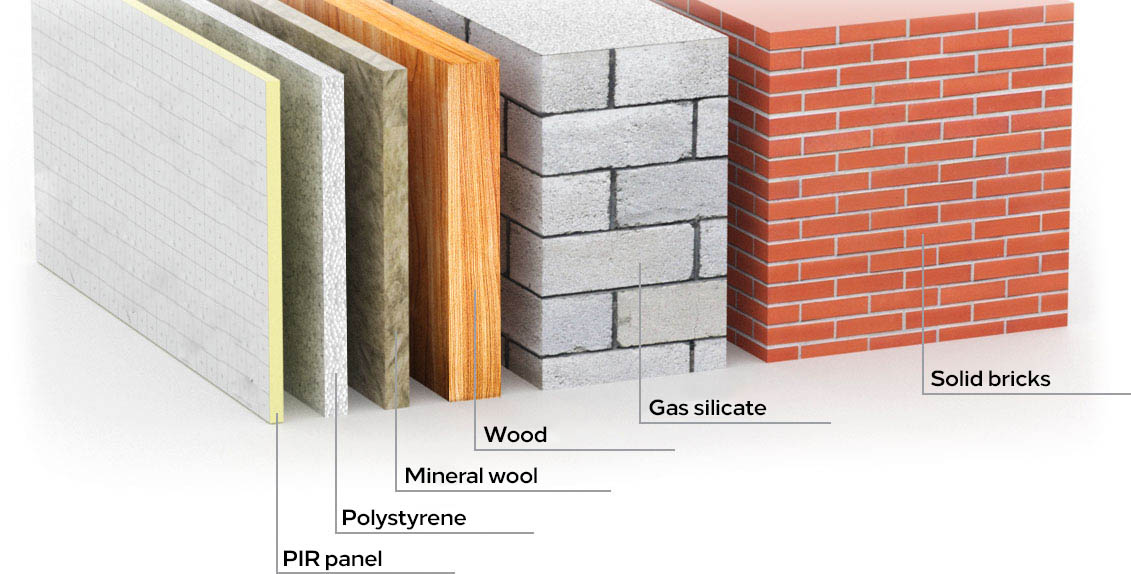
PIR is a high-tech insulation, a foamed polymer with a closed cell structure. Standard roofing PIR panels are lined with aluminum foil or other materials depending on the area of use.
PIR is mainly produced in Europe and is widely used. This thermal insulation polymer has exceptional properties, such as high resistance to open fire (flammability group G1) and the lowest thermal conductivity among all polymers (0.020 - 0.023 W/m²). It is made of many closed cells. The cells form a rigid homogeneous structure with high strength. Inside the cells there is a mixture of gases, which occupy 95-97% of the entire material volume.
The required thickness of PIR insulation is significantly less than the required thickness of all known mineral and polystyrene foam insulation materials. For instance, according to standard thermal engineering calculations, a minimum layer of 250 mm is required to insulate a flat roof using mineral wool, while only 130 mm is required when using PIR panels.
The main advantages of PIR insulation:
1. Lightweight and easy to install.
2. Lowest thermal conductivity (0.020-0.023 W/m²).
3. Fire safety. PIR plates are classified as G1 - low-combustible materials which do not support combustion. When exposed to open flames, a carbon crust forms on the insulation, which prevents the destruction of the thermal insulation layer.

4. Minimal vapor permeability and moisture absorption.
5. Strength. To create a linear deformation of 10%, you need to apply a force of 150 kPa or 1.52 kgf/cm2. Material service life exceeds 50 years.
6. Insensitive to microbiological processes (mold and fungus do not form on the surface).
7. Environmentally friendly. PIR insulation does not emit substances hazardous to human health and the environm
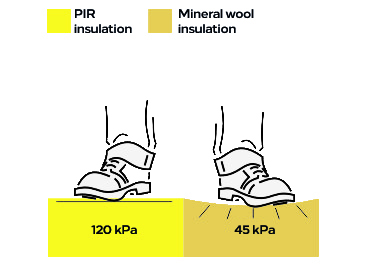
The image shows the comparative characteristics of PIR and mineral wool insulation materials.
Low compressive strength can cause dents in the roof surface. High strength ensures that the shape of the insulation and the operational properties of the roof are maintained.
Thermal conductivity comparison

Fire resistance comparison

Vapor permeability comparison (mg/m-h-Pa)

Water absorption comparison (% by volume)

Service life comparison (years)

Comparison of environmental friendliness (harmful substances content)

Low compression strength = appearance of stagnant zones on the surface of a flat roof.

- Poor sound insulation.
- Sensitivity to ultraviolet radiation.
- Low vapor permeability.
- The material is susceptible to rodent attacks.
But the most important disadvantage of this type of material is its low fire resistance. Combustion is accompanied by the release of highly toxic substances into the atmosphere - phenols, which can cause severe damage to the lungs.
Large weight. Foam glass panels are quite heavy, which significantly increases the load on the supporting structures.
Low impact strength. Foam glass is extremely poorly resistant to shock loads. At the same time, a damaged block of this insulation material loses many of its properties, for example, partially destroyed foam glass begins to leak moisture.
- Highly flammable material.
- When exposed to high temperatures, releases toxic substances.
- Poor impact resistance.