
We will call you back during our working hours between 9:00 AM and 5:00 PM
The Construction Products Regulation (CPR) came into force on July 1, 2013 and is the basis for the regulation of construction products used in all EU member states. According to the new rules of the Regulation, construction products that have not been tested and certified in accordance with the new CPR rules cannot be used in European buildings and civil engineering works. The regulation requires EU member states to reclassify all construction products using a new common test method.
One of the CPR requirements for EU Member States is to amend their regulations to include the classification system described in EN 13501 and to introduce the test methods specified in EN 13501.
EN 13501 is one of the standards for product assessment recommended by the Regulation. EN 13501, which was first issued in 2007 and updated in 2018, is used to assess the reaction of products to fire. This standard includes the following parameters:
- Reaction to fire.
- Fire resistance.
- Release of hazardous substances during normal use, dismantling and disposal.
The classification criteria and fire reaction test methods are set out in EN 13501-1 "Classification of building products and building elements by reaction to fire - Part 1: Classification by fire reaction test results". This standard defines a single procedure for classifying the reaction to fire for all building products.
Materials classification by their reaction to fire
In 2004, standardization of the European fire reaction classification criteria was introduced. Prameters such as smoke and burning droplets emission were added to the flammability concept.
Euroclasses is a European system for classifying materials according to their reaction to fire. The classification ranges from A1, which is assigned to non-flammable materials, to F, for materials whose effectiveness has not been tested.
The classification has 7 levels and is defined by the EN 13501-6 standard:
A stands for the category of completely non-flammable materials.
B1, B2, C and D refer to materials with a low fire hazard.
E – flammable materials.
F – the effectiveness of the products has not been tested.
Typically, roofing membranes are assigned class E according to their fire reaction.
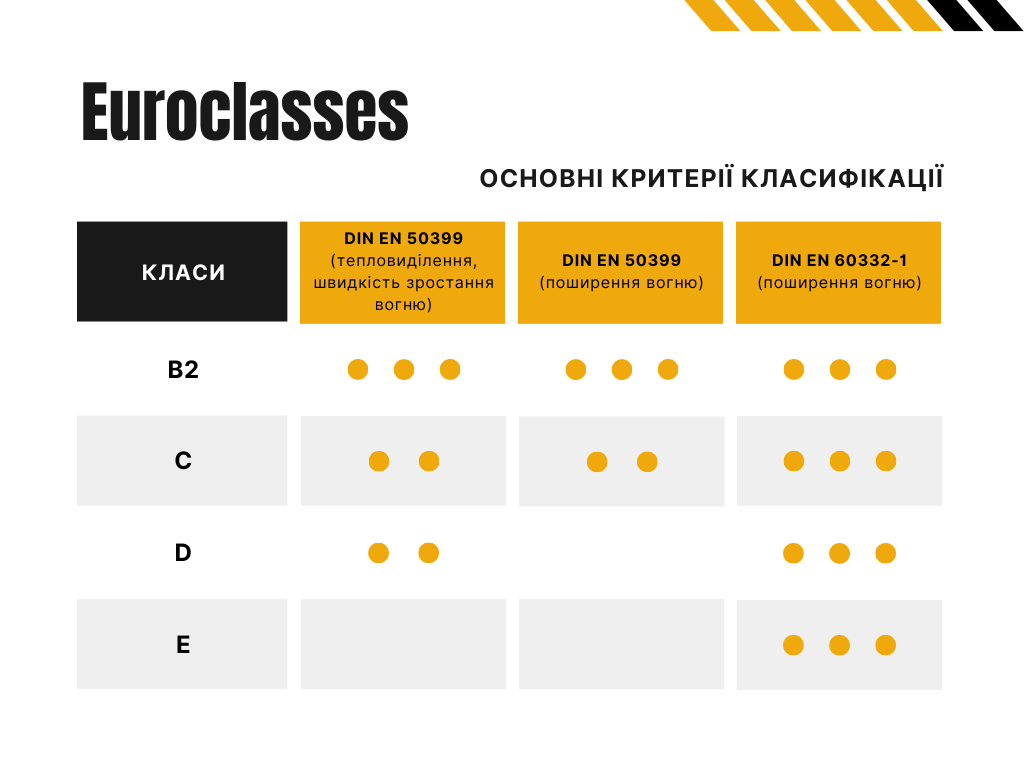
Test methods/standards covered by EN 13501-1
EN 13823: Response of materials to fire tests. All materials, apart from floor coverings, are subjected to the thermal exposure of a single burning object.
EN ISO 1182: Building product fire resistance tests – non-flammability tests.
EN ISO 1716: Reaction to fire for building materials. Total combustion heat (calorific value) calculation.
EN ISO 9239-1: Reaction to fire for floor coverings. Part 1: Combustion behavior analysis using a radiant heat source.
EN ISO 11925-2: Fire reaction test. Flammability test of building products under direct flame exposure. Part 2. Test with a single flame source.
Different tests are recommended depending on the material classification. Tests for Class F are not required since the reaction of such materials is not specified in the product documentation.
For class E, the most common class of roofing membranes, the flammability test is performed according to EN ISO 11925-2, "single source flame test".
In this test, small product samples are held vertically and a single flame source from a propane gas igniter is used to determine how quickly the material catches fire. The degree of flammability is determined by the amount of time the igniter is applied to the sample and the resulting flame height.
Class E materials are defined as those that are conducive to fire and are capable of resisting ignition by a small flame for only a short period of time. According to the test conditions, a class E material must produce a flame not exceeding 150 mm within 20 seconds when exposed to an igniter for 15 seconds. A typical example of such material is polyethylene. Products that do not meet these criteria are automatically classified as class F.
The EN 13501-1 fire resistance classification system for building materials is now also widely used outside the EU, both by countries and manufacturers wishing to trade these products with Europe and by countries wishing to establish or update their own rules without investing heavily in research and development.
Classification according to EN 13501-5
Since 2019, the European classification system BS EN 13501-5 has become the main determining criteria for roofs' external fire resistance. This classification standard provides test methods and classification criteria for roof coverings. The following classes are used at the European level: Broof(t1), Froof(t1), Broof(t2), Froof(t2), Broof(t3), Croof(t3), Droof(t3), Froof(t3) of Broof(t4), Croof(t4), Droof(t4), Eroof(t4), Froof(t4).
Fire hazard classes and test methods
The tests and classification are described in the following standards:
Test standard: CEN/TS1187: "Test methods for external fire exposure to roofs"
Classification standard: EN 13501-5: "Fire classification of construction products and building elements - Part 5: Classification using data from external fire exposure to roofs tests".
The test standard describes 4 completely different test methods, where flame spread and penetration are considered the main classification criteria. Depending on the test method, several additional measurements are made.
Test 1: Method with burning brands
Test 2: Method with burning brands and wind
Test 3: Method with burning brands, wind and supplementary radiant heat
Test 4: Two-stage method incorporating burning brands, wind and supplementary radiant heat
There is no connection or hierarchy between different testing methods. Each test has no connection to the others.
BROOF(t1) (ENV 1187, test method 1)
All of the following conditions shall be satisfied for any one test:
- external and internal fire spread upwards < 0,700 m;
- external and internal fire spread downwards < 0,600 m;
- maximum burned length external and internal < 0,800 m;
- no burning material (droplets or debris) falling from exposed side;
- no burning/glowing particles penetrating the roof construction;
- no single through opening > 25 mm²;
- sum of all through openings < 4500 mm²;
- lateral fire spread does not reach the edges of the measuring zone;
- no internal glowing combustion;
- maximum radius of fire spread on ‘horizontal’ roofs, external and internal < 0,200 m.
FROOF(t1) No performance determined.
BROOF(t2) (ENV 1187:2002, test method 2)
For both test series at 2 m/s and 4 m/s wind speed:
- mean damaged length of the roof covering and substrate < 0,550 m;
- max damaged length of the roof covering and substrate < 0,800 m.
FROOF (t2) No performance determined.
BROOF (t3) (ENV 1187, test method 3): TE ≥ 30 min and TP ≥ 30 min.
СROOF (t3): TE ≥ 10 min and TP ≥ 15 min.
DROOF (t3): TP> 5 min.
FROOF (t3) No performance determined.
BROOF (t4) (ENV 1187, метод випробувань 4):
- no penetration of roof system within 1 h;
- in preliminary test, after withdrawal of the test flame, specimens burn for < 5 min;
- in preliminary test, flame spread < 0,38 m across region of burning.
CROOF (t4):
- no penetration of roof system within 30 min;
- in preliminary test, after withdrawal of the test flame, specimens burn for < 5 min;
- in preliminary test, flame spread < 0,38 m across region of burning.
DROОF (t4):
- roof system is penetrated within 30 min but is not penetrated in the preliminary test;
- in preliminary test, after withdrawal of the test flame, specimens burn for < 5 min;
- in preliminary test, flame spread < 0,38 m across region of burning.
EROОF (t4):
- roof system is penetrated within 30 min but is not penetrated in the preliminary test;
- flame spread is not controlled.
FROOF (t4) No performance determined.
Materials flammability groups: Ukrainian classification main criteria
In Ukraine, building materials are tested for flammability, flame spread, ignition, smoke emission, and toxicity. The following characteristics are used to classify building materials by flammability:
- temperature of the gases released with the smoke;
- reduction of material weight;
- degree of volume reduction;
- duration of flame retention without a fire source.
The material and substance flammability groups are denoted by the letter G and divided into four classes: G1, G2, G3, G4.
Group G1 substances cannot burn without a flame source. However, under appropriate conditions, they can emit gases forming smoke. The temperature of the latter does not exceed 135 degrees. At the same time, the damage caused by the flame does not exceed 65% in length, and complete destruction does not exceed 20% of the total volume.
Group G2 includes materials that continue to burn for no longer than 30 seconds after the flame source is eliminated. The maximum temperature of smoke gases is 235 degrees, the damage along the length is up to 85%, and the mass loss is up to half of the total.
Group G3 includes materials that can burn for up to five minutes after the source of the flame has been eliminated. The temperature of the gases released in this case can reach 450 degrees Celsius. The length and weight are reduced in the same way as in the case of G2 materials.
Highly flammable materials are classified as G4. They are identical in all aspects to G3 substances, but the temperature of the gases released reaches 450 degrees Celsius and more.
Flammability class tests for G1-G4
Flammable and non-flammable materials are tested separately in the laboratory and in the open. Since samples may consist of several layers, each layer is tested.
Researchers and lab assistants check and calibrate the equipment prior to testing, warm it up, and then fix the test objects in special holders. The objects are placed in an oven with recorders. The sample is kept in the heating chamber until it reaches a balanced temperature. Specifically, when the fluctuation range stabilizes at 2 degrees Celsius.
To obtain the most accurate result and assign the material to the G1-4 flammability class, it is required to cool the sample in an exciter and then measure its weight and length. Based on the data obtained, the material is assigned to the appropriate group.
In the construction industry, materials cannot be used on site without testing. The safest materials are those that are non-flammable or belong to group G1.
Most often, PVC membranes are classified as G1-G2, TPE - as G2, TPO and EPDM - as G4. Thus, the least flammable membranes are PVC and TPE, and the most flammable are TPO and EPDM.
The comparison table of membranes according to their reaction to fire in different test conditions
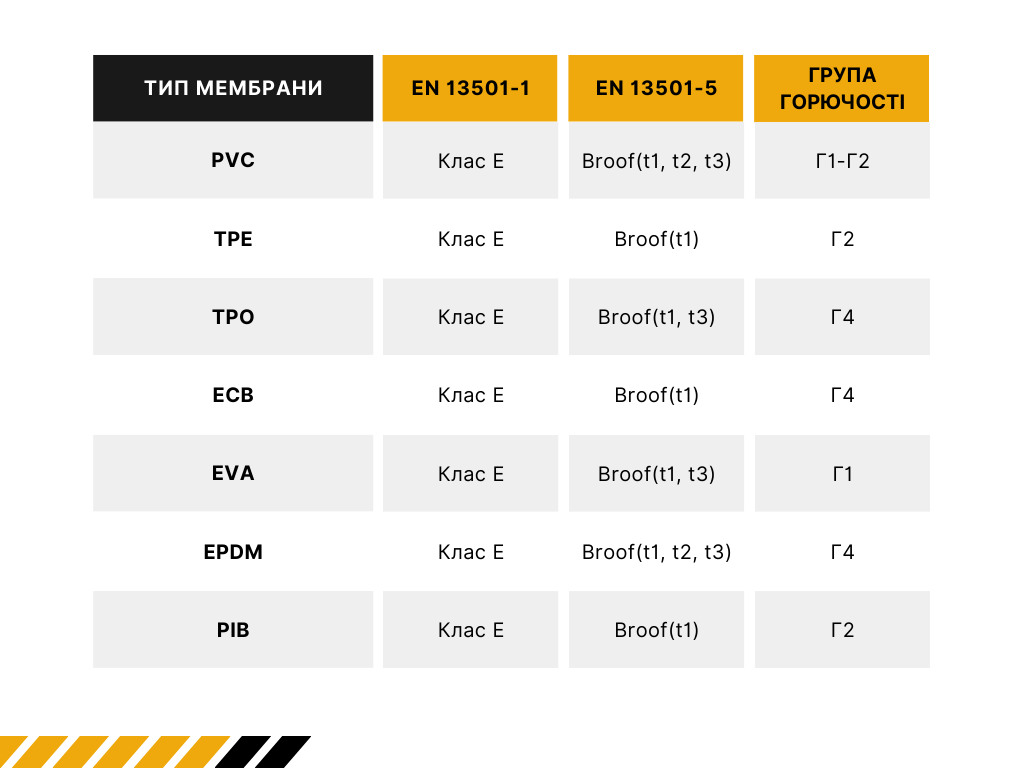
There are many types of polymer roofing membranes. The reaction of the material to fire depends on the type of polymer. As we can see from the table, according to the average scores, PVC, TPE, EVA, PIB membranes are the safest in fire conditions, and TPO, ECB and EPDM membranes are the most flammable.